Embrace Inclusion workshop programme: See the Learner, not the Label
Embrace Inclusion: See the Learner, not the Label workshop programme
Workshop lead: Sarah Wilkinson, West Kirby Educational Trust, Head of Inclusion & Clinical Services
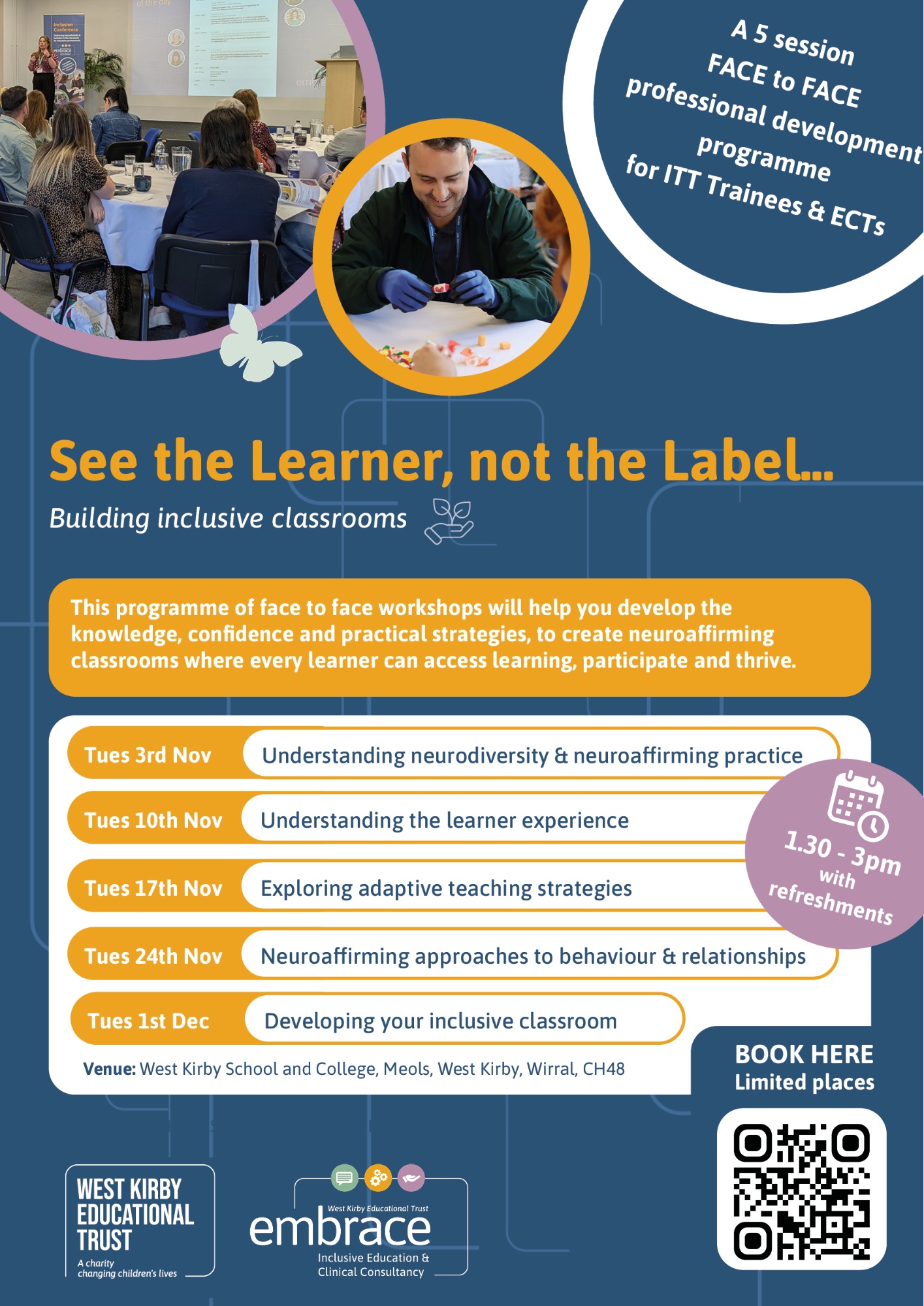
🎯 Aim: This programme of 5 face-to-face workshops will help you develop the knowledge, confidence and practical strategies, to create inclusive classrooms where every learner can access learning, participate and thrive. Aimed at ITT trainees & ECTs.
🗓️ Dates: Starting Tuesday 3rd November for 5 consecutive weeks
⏰ Time: All sessions run from 1:30 - 3pm.
Venue: West Kirby School and College, Meols Drive, Wirral, CH48 5DH
Cost: £150 per person for the complete programme. Includes session, handouts and recommended resources/reading. Payable by invoice prior to training.
Useful information:
- You are welcome to arrive from 1.15pm
- Please use the side entrance to the school hall
- Refreshments will be provided
- Parking is available on nearby roads
- For more information email embrace@wket.co.uk
Programme information below:
| Date | Session information |
|---|---|
|
Session 1. Understanding neurodiversity & neuroaffirming practice |
Participants will:
|
|
Session 2. Understanding the learner experience |
Participants will:
|
|
Session 3. Exploring adaptive teaching strategies
|
Participants will:
|
|
Session 4. Neuroaffirming approaches to behaviour & relationships |
Participants will:
|
|
Session 5. Developing your inclusive classroom |
Participants will:
|
Download the flyer below