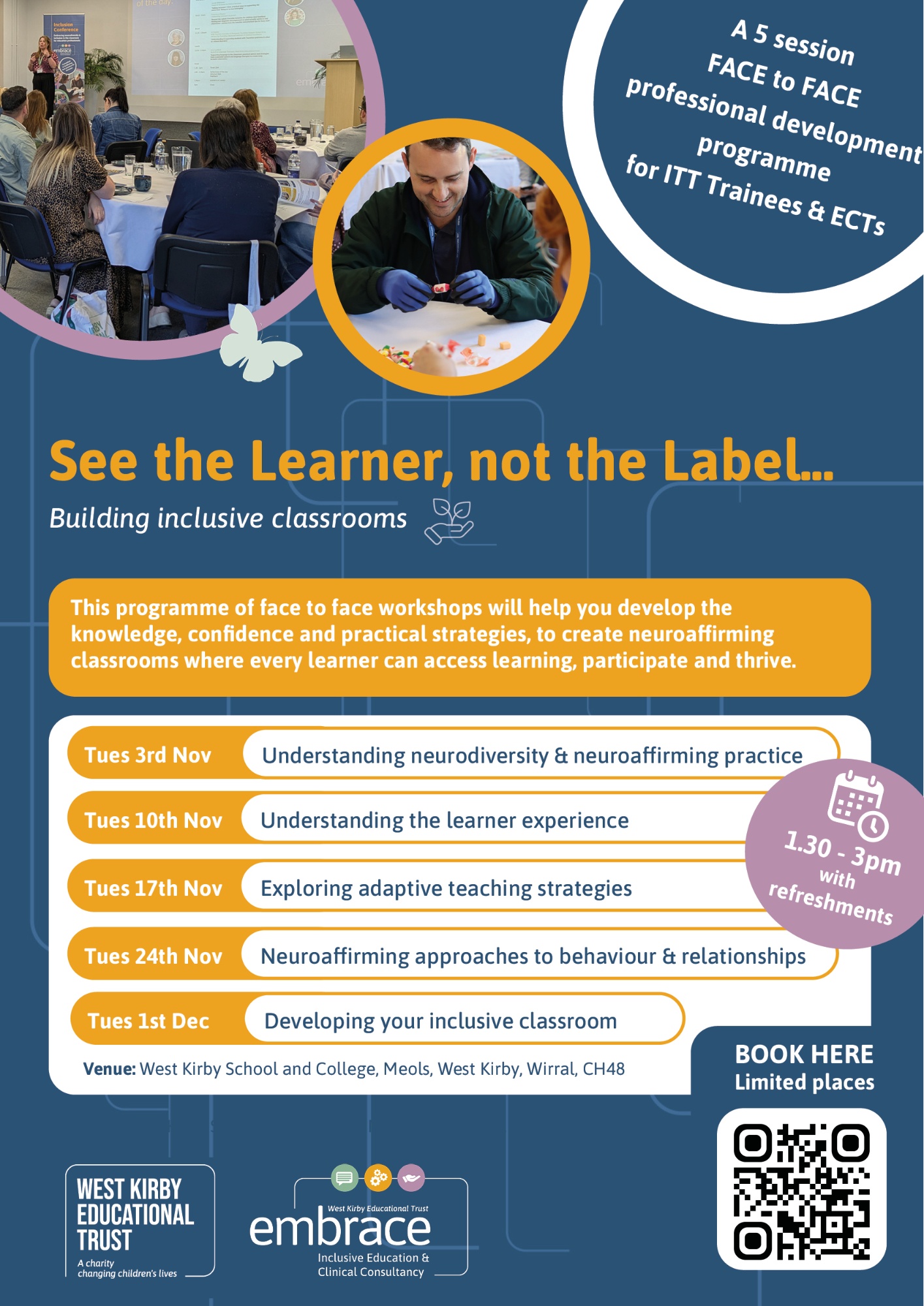
Embrace Inclusion workshop programme: See the Learner, not the Label
Embrace Inclusion: See the Learner, not the Label workshop programme
Workshop lead: Sarah Wilkinson, West Kirby Educational Trust, Head of Inclusion & Clinical Services
🎯 Aim: This programme of 5 face to face workshops will help you develop the knowledge, confidence and practical strategies, to create inclusive classrooms where every learner can access learning, participate and thrive. Aimed at ITT trainees & ECTs
🗓️ Dates: Starting Tuesday 3rd November for 5 consecutive weeks
⏰ Time: All sessions run from 1.30 - 3pm.
Venue: West Kirby School and College, Meols Drive, Wirral, CH48 5DH
Cost: £150 per person for the complete programme. Includes session, handouts and recommended resources/reading. Payable by invoice prior to training.
Useful information:
- You are welcome to arrive from 1.15pm
- Please use the side entrance to the school hall
- Refreshments will be provided
- Parking is available on nearby roads
- For more information email embrace@wket.co.uk
Programme information below:
| Date | Session information |
|---|---|
|
Session 1. Understanding neurodiversity & neuroaffirming practice |
Participants will:
|
|
Session 2. Understanding the learner experience |
Participants will:
|
|
Session 3. Exploring adaptive teaching strategies
|
Participants will:
|
|
Session 4. Neuroaffirming approaches to behaviour & relationships |
Participants will:
|
|
Session 5. Developing your inclusive classroom |
Participants will:
|